
Topics:
- Empowerment & social exchange: what motivates participation
- Stakeholder theory & collaborative governance: designing shared decisions
- Social capital in practice: tools for trust, consent, and feedback loops
- Workshop: draft a community engagement mini-plan + peer critique
Key questions:
- Which participation model (informing, consultation, co-management, community leadership) best fits your case—and why?
- How can power and interests be mapped to prevent capture and ensure free, prior, and informed consent?
- What benefit-sharing and continuous feedback mechanisms secure real community agency?
- Which capacities (skills, resources, networks) must be developed across partners to implement the engagement plan?
Key questions:
- Which participation model (informing, consultation, co-management, community leadership) best fits your case—and why?
- How can power and interests be mapped to prevent capture and ensure free, prior, and informed consent?
- What benefit-sharing and continuous feedback mechanisms secure real community agency?
- Which capacities (skills, resources, networks) must be developed across partners to implement the engagement plan?
Exploring Case 6 Fado
Anchor facts to surface: Intergenerational transmission; roles of professional & amateur fadistas; Fado houses; community agency.
Guided questions
- Who are the core/extended stakeholders (fadistas, guitarists, Fado house owners, neighborhood groups, Museu do Fado, tour operators, city cultural services) and what do they each value?
- How do mentorship and informal learning sustain transmission—and how could tourism strengthen (not replace) them?
- What would “free, prior and informed consent” look like for filming/recording inside a Casa de Fado?
- Which governance format (co-management, advisory council, house charter) is most feasible here, and why?
In-class activity (25–30 min)
Power–Interest Role-Play: Teams represent different actors and negotiate a “Fado Experience Charter” (max 10 clauses) covering consent, performance conditions, pricing transparency, and community benefit-sharing. Present and vote on the most community-empowering draft.
Digital activity (20–30 min)
Miro Stakeholder Map: Build a power/interest grid; add links and pin the different Fado players that exhibit around the world, and connect the places to Portuguese emigrant communities.
Example of the power/interest grid
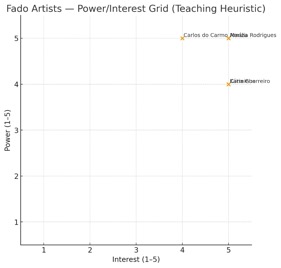
Use the map available in the e-Library as an example (cvs file). Since this map is not exhaustive, add more pins. To do so, open the CSV, append the necessary rows (Artist, City, Country, Lat, Lon, Venue/Context, Source), and then re-upload for an updated map.
You can also import to Google My Maps by uploading the CSV, styling it by “Artist,” and sharing it with your class.
Anchor facts to surface: Intergenerational transmission; roles of professional & amateur fadistas; Fado houses; community agency.
Guided questions
- Who are the core/extended stakeholders (fadistas, guitarists, Fado house owners, neighborhood groups, Museu do Fado, tour operators, city cultural services) and what do they each value?
- How do mentorship and informal learning sustain transmission—and how could tourism strengthen (not replace) them?
- What would “free, prior and informed consent” look like for filming/recording inside a Casa de Fado?
- Which governance format (co-management, advisory council, house charter) is most feasible here, and why?
efit-sharing. Present and vote on the most community-empowering draft.
Digital activity (20–30 min)
Miro Stakeholder Map: Build a power/interest grid; add links and pin the different Fado players that exhibit around the world, and connect the places to Portuguese emigrant communities.
Example of the power/interest grid
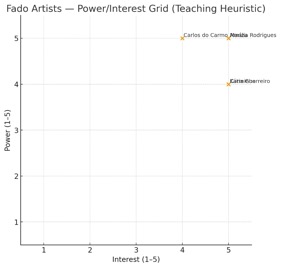
Use the map available in the e-library as an example (cvs file). Since this map is not exhaustive, add more pins. To do so, open the CSV, append the necessary rows (Artist, City, Country, Lat, Lon, Venue/Context, Source), and then re-upload for an updated map.
You can also import to Google My Maps by uploading the CSV, styling it by “Artist,” and sharing it with your class.