Who decides how a tradition is shared with the world? Who owns the stories, the songs, the rituals? If the answer is “the community”, then the community must be at the centre of every tourism decision that touches their heritage. This lesson explores the theoretical frameworks that explain why and how community involvement works — and what happens when it doesn’t.
1. Empowerment and Social Exchange: What Motivates Participation
Empowerment Theory
Empowerment theory highlights how crucial it is for communities to take charge of their own development. In tourism, this means involving residents in decision-making and ensuring their voices shape activities that affect their lives and livelihoods. Local communities hold knowledge and insights about their environment and culture that are essential for sustainable tourism planning. When communities are empowered, tourism development reflects their values, priorities, and way of life.
Social Exchange Theory
Social exchange theory suggests people engage based on their assessment of costs and benefits. Residents are more likely to participate in tourism initiatives if they believe the benefits — economic gains, improved infrastructure, cultural revitalisation — outweigh the downsides, such as environmental harm or cultural commodification. This means: distribute benefits fairly, address community concerns openly, and never take participation for granted.
Key principle: If communities feel exploited, they will disengage — and the heritage will suffer.
2. Stakeholder Theory and Collaborative Governance: Designing Shared Decisions
Stakeholder Theory
Stakeholder theory highlights the need to consider the interests of everyone impacted by tourism development: local communities, tourists, businesses, governments, and NGOs. Effective planning means recognising how interconnected these stakeholders are and working toward collaborative solutions that honour the rights and interests of all involved.
Collaborative Governance
No single organisation has all the resources or expertise needed for successful tourism development. Collaborative governance promotes shared decision-making, joint problem-solving, and mutual learning among stakeholders. It complements stakeholder theory by showing how to put multi-party engagement into practice.
| Framework | Core Idea | Tourism Application |
|---|---|---|
| Empowerment | Communities lead their own development | Residents co-design tourism experiences |
| Social Exchange | Participation follows perceived benefit | Fair economic distribution motivates engagement |
| Stakeholder | All impacted parties have interests | Inclusive planning across all groups |
| Collaborative Governance | Shared decisions beat unilateral control | Partnerships between government, NGOs, businesses, communities |
| Social Capital | Trust and networks enable collective action | Building community cohesion before tourism development |
3. Social Capital in Practice: Tools for Trust, Consent and Feedback
Social capital theory highlights how social networks, trust, and reciprocity play a crucial role in community development. Practical tools include:
- Community consent protocols — free, prior, and informed consent (FPIC) before any recording, filming, or commercialisation of cultural practices.
- Benefit-sharing agreements — transparent mechanisms distributing tourism revenue to tradition bearers.
- Community advisory councils — ongoing governance structures with real decision-making power.
- Feedback loops — regular consultation, monitoring surveys, and community-led evaluation of tourism impacts.
4. Workshop: Draft a Community Engagement Mini-Plan
Based on an ICH element from your country, draft a 1-page community engagement mini-plan that includes:
- Participation model chosen (informing, consultation, co-management, or community leadership) and justification.
- Power and interest mapping of all stakeholders.
- One concrete benefit-sharing mechanism.
- One feedback loop mechanism.
- Two capacity needs to address (skills, resources, or networks).
Exploring Case 6 — Fado in Lisbon
Anchor facts: Intergenerational transmission; roles of professional and amateur fadistas; Fado houses as governance spaces; community agency over performance spaces and narratives.
Guided Questions:
- Who are the core and extended stakeholders (fadistas, guitarists, Fado house owners, neighbourhood groups, Museu do Fado, tour operators, city cultural services) and what does each value?
- How do mentorship and informal learning sustain transmission — and how could tourism strengthen (not replace) them?
- What would “free, prior and informed consent” look like for filming or recording inside a Casa de Fado?
- Which governance format (co-management, advisory council, house charter) is most feasible here, and why?
→ In-Class Activity: Power–Interest Role-Play (25–30 min)
Teams represent different Fado stakeholders and negotiate a “Fado Experience Charter” — maximum 10 clauses covering:
- Consent protocols for visitors, photographers, and media.
- Performance conditions (authenticity standards, no interruption rules).
- Pricing transparency and ticket allocation (locals vs. tourists).
- Community benefit-sharing (% of revenue to artist fund, apprenticeship programme).
Present drafts. Class votes on the most community-empowering version.
→ Digital Activity: Miro Stakeholder Map (20–30 min)
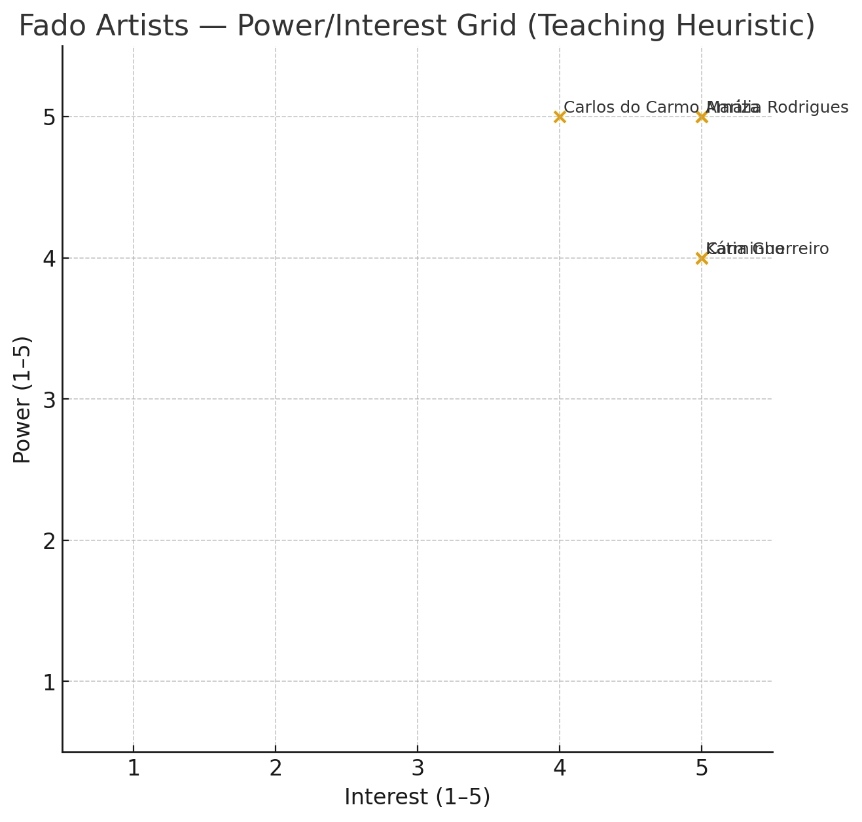
Miro Stakeholder Map: Build a power/interest grid; add links and pin the different Fado players that exhibit around the world, and connect the places to Portuguese emigrant communities.
Example of the power/interest grid:
You can also import to Google My Maps by uploading the CSV, styling it by “Artist,” and sharing it with your class.
Use the map available in the e-library as an example (cvs file). Since this map is not exhaustive, add more pins. To do so, open the CSV, append the necessary rows (Artist, City, Country, Lat, Lon, Venue/Context, Source), and then re-upload for an updated map.
Key Questions
- Which participation model (informing, consultation, co-management, community leadership) best fits your case — and why?
- How can power and interests be mapped to prevent capture and ensure free, prior, and informed consent?
- What benefit-sharing and continuous feedback mechanisms secure real community agency?
- Which capacities (skills, resources, networks) must be developed across partners to implement the engagement plan?